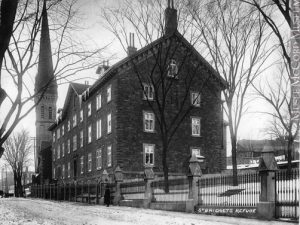
“St. Bridget’s Refuge, Montreal, QC, vers 1896.”. McCord Stewart Museum, Montreal, QC.
The Irish Potato Famine, An Gorta Mór, (1845-1852) was marked by its unfortunately high death toll, but also by its mass emigration. It is estimated that during 1847 alone, approximately a million people exited their home country as staying equated to death. In search of a new refuge, about 100,000 of those migrants left for British Canada. Most settled in the eastern provinces; places that would later become New Brunswick, Nova Scotia, Ontario, and Quebec.
In 1869, the Grey Nuns acquired a vast four stories tall building and founded the St-Bridget Refuge in Montreal, Quebec, which was more commonly known as St-Bridget’s Home or St-Bridget’s Asylum in its later years. Not only would it serve as a refuge for the older folk, but the Nuns would also assist unemployed women by offering them housing and aid with their job searches. They would even sometimes visit and help the ill of the neighborhood, and, at night, the Home would welcome the homeless.
As for recent developments, in 2018, University of Montreal (UDEM) purchased a lot from St-Patrick’s Basilica; a lot that was previously occupied by the refuge. In 2024, the university opened a new HEC (Hautes Études Commerciales) pavilion on their newly acquired grounds. In response to the community’s worries about this pavilion being situated on a rich cultural and patrimonial landmark, UDEM retraced the foundations of the refuge both inside and outside of the building and installed commemorative plaques.
Fergus Keyes has kindly donated to the CIMPN a ledger of 3,317 names of people who have once frequented the St-Bridget’s. This record sometimes includes additional information on its past occupants such as their occupation, their age, their date of transfer, their date of departure, or their date of death.
The scanned original ledger and a searchable list of names are now available in our Digital Library.