By Kelley O’Rourke
SACRED TO THE MEMORY OF
EDMUND BAILEY O’CALLAGHAN M.D. LL.D
THE HISTORIAN OF NEW NETHERLAND AND THE ARCHIVIST OF NEW YORK
BORN AT MALLOW IN IRELAND THE 29 OF FEB. 1800
DIED AT THE CITY OF NEW YORK THE 29 OF MAY 1880
Blessed are the dead who die in the Lord
In Old Calvary Cemetery in Queens, New York, an imposing black monument marks the grave of Edmund Bailey O’Callaghan, one of the most fascinating Irish figures connected to nineteenth-century Quebec history. The monument describes him as a physician, historian of New Netherland, and archivist of the state of New York. It proudly notes his Irish birthplace at Mallow and reflects the prominence he achieved following his exile from Lower Canada after the Rebellions of 1837 – 1838.
Yet for all the information carved into the stone, the monument leaves out some of the most personal parts of his story.
Edmund Bailey O’Callaghan and the Quebec Patriots
After studying medicine in Dublin in 1920, then in Paris, he immigrated to Lower Canada, where O’Callaghan became deeply involved in the Parti patriote movement and emerged as one of its strongest voices becoming editor of The Vindicator, in April 1833 after the death of its founder, Dr. Daniel Tracey. The Vindicator was an influential Irish-Montreal newspaper that supported reform and the Parti patriote cause. Following the failure of the rebellion, O’Callaghan fled to the United States where he rebuilt his career and eventually became one of New York’s leading historians and archivists, where he published, in 1849, his book on the influence of the Dutch in New York, which he termed the New Netherlands”.
The Monument
The monument itself reflects Victorian-era memorial culture. A draped urn crowns the stone, symbolizing mourning and the passage from earthly life to the next. Ivy carved into the monument represents remembrance and immortality, while the Latin cross affirms O’Callaghan’s Catholic faith. The size and dark stone project permanence, prestige, and accomplishment.
But absent from the monument are the names of the women and children closest to him.
Nowhere does it mention his first wife, Charlotte Augustina Crampe, whom he married in 1830, in Sherbrooke, or their son, Jean Baptiste Edmund O’Callaghan, both of whom died in Montreal in 1835 and were buried in the former St. Antoine Catholic Cemetery — today the site of Place du Canada. Also omitted are his second wife, Ellen Hawe, and their daughter Mary Ann O’Callaghan, who died at only two years of age.
These omissions reveal much about nineteenth-century attitudes toward memory and commemoration. Victorian monuments frequently celebrated the public accomplishments of men while overlooking the lives and identities of wives and children. In O’Callaghan’s case, the monument immortalizes the political figure and intellectual while quietly erasing his family life.
One overlooked detail makes this silence even more intriguing.
The Opposition
Charlotte Auguste Crampe’s sister, Elizabeth Crampe, married Captain Guy Carleton (Colclough) — placing O’Callaghan within a family network connected to the colonial establishment he fiercely opposed during the Patriote movement. It is a remarkable connection rarely discussed in biographies of O’Callaghan. One can only imagine the political tensions these family relationships may have created in pre-Rebellion Lower Canada and especially given Captain Guy Carlton was a decorated British Arm Captain and the nephew of Lord Dorchester.
Today, O’Callaghan’s monument stands not only as a tribute to his accomplishments, but also as a reminder of the stories left untold in historical memory. The absence of Charlotte, Ellen, Jean Baptiste Edmund, and Mary Ann raises important questions about who is remembered, who is forgotten, and why.
Their stories deserve to be explored not merely as footnotes to Edmund Bailey O’Callaghan’s life, but as individuals whose lives and absences reveal another side of nineteenth-century Irish, Montréal, and Québec history.
Sources:
Ardolina, Rosemary Muscarella. Old Calvary Cemetery: New Yorkers Carved in Stone. Westminster, Md.: Heritage Books, 2007.
Guy, Frank Shaw. Edmund Bailey O’Callaghan; a Study in American Historiography (1797-1880). Studies in American Church History, v. 18. New York: [AMS Press], 1974.
Verney, Jack. O’Callaghan: The Making and Unmaking of a Rebel. 1 online resource (258 pages) vols. Carleton Library Series, #179. Ottawa Ont.: Carleton University Press, 1994. https://www.deslibris.ca/ID/403865.
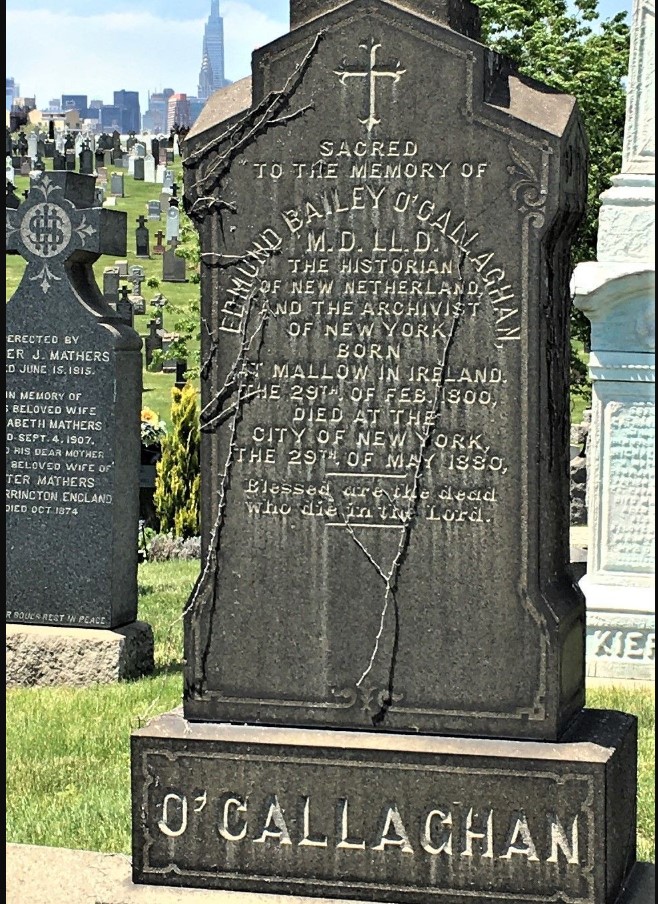
Figure 1. Front of Edmund Bailey O’Callaghan’s headstone in the Cavalry Cemetery, New York – Image credit: Ines Fada, Find A Grave (May 16, 2021)