
By Kelley O’Rourke
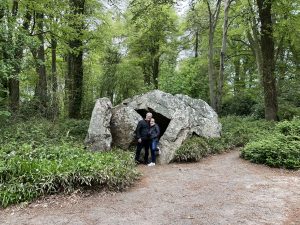
Greg and Kelley – Howth
During a visit to Ireland in May, CIMPN director Linda Fitzgibbon, Gregg Thomassin and I visited Aideen’s Grave on the grounds of Howth Castle.
The walk through the wooded pathways of the castle estate was unforgettable. Surrounded by blooming rhododendrons and ancient trees, the trail led us to one of Ireland’s most significant prehistoric monuments — an early Neolithic portal tomb dating to approximately 3800 BC.
Often referred to as a dolmen or cromlech, Aideen’s Grave was constructed from local quartzite stone and consists of a massive capstone balanced upon upright portal stones. The site is also deeply connected to Irish folklore. According to legend, the tomb commemorates Étaín Fholthinn, or Aideen, who died of grief after the death of her husband Oscar, grandson of the legendary Fionn MacCumhaill.
The monument was later immortalized in poetry by Irish antiquarian Samuel Ferguson in The Cromlech on Howth (1861).
Visiting Aideen’s Grave was a powerful reminder of how landscape, mythology, archaeology, and storytelling remain intertwined within Irish heritage. Sites like this continue to inspire reflection on memory, preservation, and the enduring importance of place.